Monday, July 31, 2006

Saddam and Syria in the news


I've long since returned from vacation, but I've been terribly remiss in updating this blog. Then again, most of the world's dictators have been laying low. I'm not the only one who takes some vacation time in the summer, after all!

One dictator who has been in the news lately is former Iraqi strongman Saddam Hussein who has recently broken his hunger strike, and told his prosecutors that, if convicted, he would rather be shot by a firing squad than hanged. In this age of execution by lethal injection, we have become somewhat squeamish about capital punishment, and some people may have forgotten that hanging is a punishment traditionally reserved for common criminals - an indignity Saddam feels is beneath him as befits his status as president of Iraq. Well, former president of Iraq, but Saddam has never quite accepted his demotion from "president" to "defendant" in a graceful way.

Staying the Middle East, one may have noticed the current dust up between Israel and Hezbollah. I cannot help but wonder: was the Hezbollah offensive that triggered this war part of a power play by Syrian dictator Bashar al-Assad to strengthen Syria's weakening grip on its former client state, Lebanon?

After the hamfisted assassination of Rafik Hariri and the subsequent diastrous (for Syria, anyway) Cedar Revolution, it seemed Lebanon's days as a de facto Syrian colony were at an end. Could the junior Assad be as inept as the senior Assad was shrewd? Are Damascus and Tehran waging their proxy war against Israel to satisfy hard liners domestically? Does Assad hope to reverse Syria's loss of regional influence? Most importantly, why has Assad been silent during the fighting? Obviously, Assad doesn't dare challenge Israel directly, and he certainly won't be sending the Syrian military back to Southern Lebanon while the nearly invincible Israeli military is there. Given the current anti-Israeli mood in Europe and the United Nations, it seems safe to bet that he's weighing the pros and cons of jumping back into Lebanon the very second the Israelis pull out.

I have always thought Bashar al-Assad to be a shadow of the dictator his father was, but if he's looking through his father's old playbook for the next move, I may be forced to review my estimation of his skills as a dictator.

Monday, June 19, 2006

Something I need to clear up

Galloway flirting with Uday Hussein

When I admit to having an unhealthy interest in dictators, I should hasten to add that this does not mean I actually like the bastards, but rather, that I find the social, political and economic aspects of totalitarian rule fascinating. After all, most dictators are completely loathesome people prone to doing absolutely unspeakble things to their captive populations. So what sort of an asshole would actually suck up to a dictator he's not in fear of?

Meet British MP George Galloway, my American friends, the sole member of the RESPECT party. When he's not busy sucking up to the likes of Saddam Hussein and Syran dictator Bashar al-Assad, he's often busy advocating the mutiny of British troops in Iraq and begging the tyrants he flatters to line his pockets. That is, of course, when he's not siphoning monies from the charity he's established. Or looting the late, unlamented, UN sponsored "oil-for-food" program. After all, how can one expect a humble public servant afford a Mercedes and a villa in Portugal on a public servant's salary?

While some people may feel that I have a genuine affection for dictators, I don't really. After all, I'd certainly hate to be mistaken for a douchebag like my good pal George Galloway. A greatest hits PDF file can be examined here. Be careful: it may induce vomiting.

Friday, June 16, 2006

The Caracas Chronicles

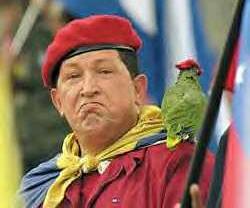
I've found a wonderful blog covering the socio-economic conditions surrounding Venezuelan strongman Hugo Chavez (seen above, having put a beret on a defenseless amazon parrot). Though the author says he isn't quite ready to use the word "dictator" to describe Chavez, he certainly would describe him as an autocrat. Read The Guide to Venezuela In The Chavez Era over at the marvelously entertaining Caracas Chronicles.

Monday, June 12, 2006

The world's game!

It's World Cup time again, and you know what that usually means? Europe and Brazil versus a smattering of the world's least democratic societies in a game Americans are bored to death by. Only this year, actual dictatorships appear to be poorly represented among the 32 nations participating in the big soccer thing-y.

Togo, perhaps the worst team to ever actually make into the World Cup, stands relatively alone as one of the only bonafide dictatorships represented in Germany this year, thanks to the succession of Faure Gnassingbé's succession of his father's dictatorship in May of 2005. Saudi Arabia could also qualify, although some hold monarchies to a separate standard (I don't). What's the world coming to?

Saturday, May 27, 2006

Marxists.org

Well, someone's still got to believe in the struggle of the proletariat, right? The Marxists Internet Archive is a virtual treasure trove relating to the 20th century's deadliest joke. In addition to Das Kapital and The Communist Manifesto, marxists.org provides a treasure trove for dictator fans. I nearly blew my top reading about Enver Hoxha's meetings with Josef Stalin!

Extensive collections are also available on Lenin, Mao, Fidel Castro, Tito, but the fun doesn't stop there - even Stalin's wacky pet "scientist" Trofim Lysenko (who believed in a "Marxist" theory of trait inheritence instead of genetics) is accounted for. How anyone took this deadly gibberish seriously - or how anyone still could - is left as an exercise in imagination for the reader.

Sunday, May 21, 2006

Dictator chic

Courtesy of Reason Magazine's Hit and Run blog, links to articles by Ian Buruma and Christopher Hitchens at the Sunday Times (London) on the lingering support for authoritarianism on left dating back to the Communist insurgencies of the post-War 20th century.

Indeed, from the days Pete Seeger was known as "Stalin's Songbird" to Sean Penn performing Saddam Hussein's public relations work, the American left has, at times, tripped over its own feet to praise the likes of Hugo Chavez, Fidel Castro, the North Korean Kim dynasty, Pol Pot, Joe Stalin and many more. To be sure, anti-Americanism plays a part, but what else is behind the curious symbiosis between the American far-left and the worship of totalitarian power?

Buruma's article analyzing Western support for leftist totalitarianism may be read here, while Hitchens case for the left abandoning support for dictatorships to restore political credibility may be found here.

Sunday, May 14, 2006

Top 10 Profile: Nicolae Ceauşescu

Name: Nicolae Ceauşescu
Born: January 26, 1918 in Scorniceşti, Romania
Died: December 25, 1989 in Târgovişte, Romania
Length of rule: July 11, 1965 - December 25, 1989 (33.5 years)
Means of ascent to power: leading Romania's communist party
Means of removal from power: overthrown in a coup d'état and executed
Style: Police state, cult of personality, Stalinist quasi-monarchy

NOTES:

On Christmas Day in 1989, the entire world was given a gift. After being overthrown in a coup d'etat, Nicolae and wife Elena Ceauşescu were convicted on the charge of genocide by a revolutionary kangaroo court, led down to a dingy basement, and shot to death by an army officer wielding a submachine gun. Normally, the civilized world frowns on coups, kangaroo courts and capital punishment, but in this case, the world kept quiet.

For over 30 years, Nicolae Ceauşescu and his wife Elena turned the Warsaw Pact nation of Romania into a laboratory for fear, misery and poverty. Assuming power in 1965 after the death of his predecessor, Ceauşescu quickly consolidated power by neutralizing his political rivals in the Romanian Communist Party, and by reorganizing the structure of Romania's dreaded secret police organization (the infamous Securitate) into a tool capable of completely repressing public political expression and dissent. He was just warming up.

Following a visit to fellow dictator Kim il-Sung in 1971, Ceauşescu apparently realized that he had been something of a piker as a dictator when compared to the godlike Kim. Taking cues from North Korea, Ceauşescu embarked on the creation of a "his and hers" dictatorship by means of a personality cult devoted to himself and his wife Elena, while also embarking on a disastrous policy of economic collectivization that transformed an already economically fragile nation into a poorhouse.

Apparently feeling that there were too few Romanians to lord over, Ceauşescu banned both contraception and abortion, leading an explosion of children that could not be fed, housed, nor cared for. This population explosion led to an increase in Romania's foreign debt, which Ceauşescu unwisely helped deal with by exporting Romania's already insufficient grain harvest, thus creating poverty and food shortages extreme even by the standards of a Communist country. With the exception of Enver Hoxha's isolationist dictatorship in Albania, the Ceauşescus excercised a personal control of a nation unknown in Europe since the death of Josef Stalin.

By the late 1980's, the entire Warsaw Pact began to collapse around Ceauşescu's ears. Without international support, nobody was willing to spend any amount of time, money or manpower to prop up Ceauşescu's decrepit autocracy, and in 1989, the end finally came.

After rising economic discontent led to an unprecedented public demonstration and uprising in the city of Timişoara, Ceauşescu ordered the Securitate and Romanian army to brutally disperse the crowds and punish the leaders of the demonstration.

After returning from a state visit to Iran, Nicolae and Elena Ceauşescu were horrified to find that the demonstrations had spread to Bucharest, and that during their two day absence, the leadership of the Securitate and Romanian army wisely decided to shift their loyalties from the despised Ceauşescus and launched a coup d'etat. The Ceauşescus never had a chance.

The dictator and his wife attempted to flee by helicopter, but were grounded by orders of the new anti-Ceauşescu military. Attempting to flee by car, they were stopped by civilian police in Târgovişte. The police detained the "mother and father of Romania" in the back seat while listening to the radio to determine if the anti-Ceauşescu coup would succeed. It did.

On Christmas Day in 1989, it was all over, and pictures of Nicolae and Elena Ceauşescu's bullet ridden bodies were sent to foreign press outlets over the world, without so much as a peep of protest. It seems that the entire world had finally had enough of the loathesome Romanian strongman and his insufferable wife.

What set Ceauşescu apart from some of his contemporaries was the enormous lingering damage done to Romania's social and economic fabric. While other Eastern European nations have recovered from the damage done by Communism, Romania's enforced population boom created millions of orphaned children, many of whom were infected with HIV by Romania's miserable public health system. To this day, Romania lags behind her former Warsaw Pact allies in Poland, Hungary and elsewhere in every measureably standard of economic and social progress, and all because of the megalomania of Nicolae and Elena Ceauşescu.

Wednesday, May 10, 2006

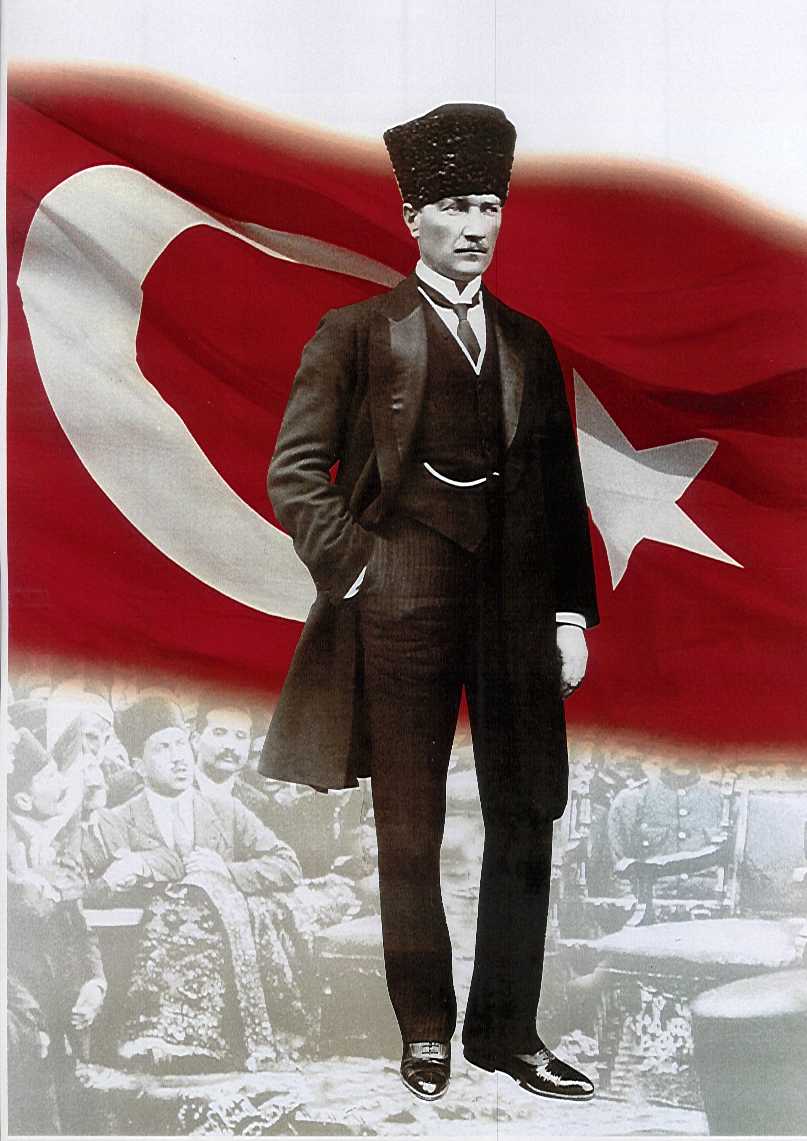
Top 10 Profile: Kemal Atatürk

Name: Mustafa Kemal Atatürk
Born: Thessaloniki, Greece (formerly part of the Ottoman Empire) 1881
Died: Istanbul, Turkey November 10, 1938
Length of rule: 15 years (October 1923 until his death in 1938)
Means of ascent to power: Military victory
Means of removal from power: Died while in power
Style: Benevolent dictatorship, cult of personality

NOTES:

It may be argued that no other 20th century leader has left so large a mark on his nation as Kemal Atatürk. Following the defeat of the Ottoman Empire in World War One, Atatürk rebuilt his nation from the ground up.

Atatürk's most notable, almost impossible, achievement was the transformation of the Islamic Ottoman Empire into the politically secular Republic of Turkey. On paper, this doesn't seem very impressive, but the political and social impact changed the face of the Muslim world forever. Continuing from there, Atatürk remolded the image of his people from the pan-Islamic religious identity into a solidly Turkish nationalist one. Atatürk turned away from the Middle East and looked towards Europe for new modes of dress, and even introduced orthographic reform for the Turkish language by abolishing the Arabic script Turks had used for centuries and mandating the use of the Roman alphabet.

Since his death, Atatürk has become the embodiment of Turkey and of Turkishness. Indeed, criticism of Atatürk is unthinkable - even illegal - in Turkey to this day. None of the other dictators on my top 10 list (not even Mao or Stalin) have had the same lasting social, cultural or political impacts on their subjects as Atatürk has had on his.

Tuesday, May 09, 2006

Top 10 awards

Parade Magazine has their top 10 list of dictators, and now I have mine. I have created a sidebar with links to Wikipedia biographies corresponding to my list of the top 10 dictators of the past 100 years. Unlike Parade's listing, I have included some tyrants who, thankfully, have shuffled off this mortal coil. In the short future, I will be providing short biographies and summaries of these autocrats, including notes on their respective ideologies and styles.

Who's Hot, and Who's Not

Like any other international celebrities, dictators find themselves victims of the vicissitudes of fortune. Sometimes you're up, sometimes you're down. Let's examine the cases of the dictators pictured above in a fraternal, socialist hug: Hugo Chavez of Venezuela and Robert Mugabe of Zimbabwe.

HOT: Hugo Chavez

The standard bearer of the "Bolivarian revolution" is standing tall. After starting his career in politics by launching an unsuccessful coup d'etat, Chavez was elected President in 1999 by popular vote, and since then, has survived an attempted coup d'etat to remove him in 2002. His coffers filled to bursting by sky high oil prices, Chavez has circled the globe wooing the international left, from his hero Fidel Castro to celebrity admirers in the United States. While Chavez has been fêted abroad, he's been cracking down on his political enemies and potential rivals at home. Even his paranoid anti-semtism - a potential liability - has been ignored as long as Chavez styles himself as America's #1 enemy. Chavez is red hot.

NOT HOT: Robert Mugabe

At the opposite end of the thermostat lies Zimbabwe's 82 year old dictator, Robert Mugabe. Like Chavez today, Mugabe once found himself as the darling of the international, socialist left. After leading the military and political opposition to the racist, breakaway British colony of Rhodesia, Mugabe won the first free and ostensibly fair election in the newly christened nation of Zimbabwe. An avowed Marxist who publically pledged himself to instituting single party rule in Rhodesida, Mugabe at first reached out to foreign leaders, and even his old foes, to present himself as a cautious and pragmatic democrat.

The honeymoon was very short lived. Almost immediately after taking power Mugabe has used North Korean trained state security services to brutalize his political enemies, and has gone on to completely destroy the nation's economy, hold multiple rigged elections, harass his political opposition, and even declare war on homosexuals at home and abroad. In the 26 years he has led Zimbabwe, Mugabe has shown more interest in rewarding his friends and punishing his enemies than he has in solving Zimbabwe's intractable social and economic problems.

Having directly caused the economic and social collapse of what was the once of the most economically and politically successful nations on the continent *, the only thing left for Mugabe to do is desperately try to cling to the top of the dung heap has transformed the Zimbabwe into until he dies.

* "You have inherited a jewel. Keep it this way" - Mozambique's Samora Machel to Robert Mugabe, 1980

Monday, May 08, 2006

Have you heard the one about ... ?

What did Soviet strongman Josef Stalin and Romanian tyrant Nicolae Ceauşescu have in common? They both loved a good joke! Well, not exactly, but Ben Lewis has written an enthralling essay on the role of political jokes behind the Iron Curtain. Besides the analysis of the role of jokes inside repressive political systems, some of the jokes are actually pretty good. My favorite thus far is this gem rumored to be told by Stalin himself:

"Stalin himself cracked [jokes], including this one about a visit from a Georgian delegation: They come, they talk to Stalin, and then they go, heading off down the Kremlin's corridors. Stalin starts looking for his pipe. He can't find it. He calls in Beria, the dreaded head of his secret police. "Go after the delegation, and find out which one took my pipe," he says. Beria scuttles off down the corridor. Five minutes later Stalin finds his pipe under a pile of papers. He calls Beria--"Look, I've found my pipe." "It's too late," Beria says, "half the delegation admitted they took your pipe, and the other half died during questioning."

Oh sure, today's politicians are handy with self-deprecation, but it's almost impossible to imagine the fear that must have seized anyone hearing Stalin joke about himself. Would you dare laugh? Would you dare stay silent? More than any joke,the paralyzing fear of someone unable to know how to react was exactly the sort of thing Stalin found hilarious.

Suharto at death's door?

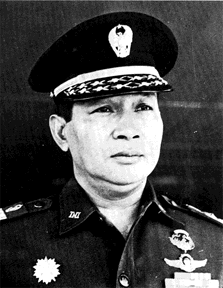
No matter how powerful a man is, his common destiny with other men is age, infirmity, and death. Reports from Jakarta state that Indonesia's 84 year old former dictator Suharto* has undergone an operation, his fourth in the past calendar year, to remove a 25 inch section of his intestines. Time is obviously not on Suharto's side, and even if he does recover, he's facing a criminal trial on corruption charges.

Suharto's rise to power began in a time honored way after overthrowing the incumbent "President for Life" Sukarno in military coup d'etat in 1965. For the next 33 years, Suharto became the world's most successful kleptocrat, embezzling incredible sums estimated to be as high as $35 billion US dollars. On the domestic front, Suharto famously repressed the independence movement in the former Portuguese colony of Timor Leste ("East Timor"), for which Suharto earned the eternal disapproval of the Noam Chomskys of the world.

Not surprisingly, Suharto had much more to worry about than the finger waggling of crackpot American academics, as his nation was constantly wracked with economic crises, guerilla insurgencies, and ecological disasters that would stretch the governing skills of any dictator, much less one more interested in looting his nation's coffers than than steering the ship of state. Yet through it all, he managed to keep his grip on for over 30 years, an astounding length of time for a dictator in a such a politically unstable region.

Ironically, the daughter of the dictator he had deposed on his way to the top proved instrumental in Suharto's political collapse, but perhaps the sad fact of the matter is that time had passed Suharto by. Once upon a time, Suharto could count on political and economic support from Washington, but with the end of the Cold War, Washington stopped going steady with Jakarta and decided to "just be friends". While this was obviously bad news for Suharto, it was excellent news for Indonesia and East Timor, and you would now be hard pressed to find anyone alive or dead who yearns for the return of one man rule to Indonesia.

Before he dies a feeble and powerless old man, let us take a moment to remember him as one of the richest, most powerful, and most loathesome men to live in the 20th century while he's still alive, shall we?

* Most Indonesians go by a single name - see here for details.

Friday, May 05, 2006

Strongman in the Sudan

While the world is buzzing about the humanitarian nightmare in the Darfur region of Sudan, one man has curiously escaped much of the attention and scrutiny being paid to events in a nation suddenly thrust into the spotlight: Sudan's military dictator, Field Marshal Omar Hassan Ahmad al-Bashir.

Since Bashir got the best of Sudan's former ideologue strongman (and Osama bin Laden backer) Hasan al-Turabi in 2000 power struggle, the Khartoum government has ended one genocidal conflict and begun another in Darfur. While the world's great powers have made indignant noises about the enormous scale of suffering inflicted in Darfur, none of them have mentioned the man who's responsible for waging a proxy war against his own people, or where he gets his support from. Having shrugged off the civilized world's attempts at avoiding solving the crisis without military intervention, al-Bashir dismissed foreign sanctions by saying, "we have learned to rely on ourselves".

Cynically (if masterfully), al-Bashir is playing coy with foreign powers by halfheartedly committing to talks on Darfur. It's not rocket science - as al-Bashir has long realized that the glacial pace of international diplomacy gives him all the time he needs to finish the job in Darfur, and insuring that he will still be in power long after his genocidal victory at home.

Monday, May 01, 2006

The last dictator in Europe

Since the collapse of the Soviet Union, most Americans have given little thought to what happened with the corpse. After all, we won the cold war, right? Case closed.

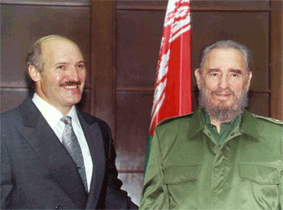
Those of us who are fascinated by dictators know that the Soviet implosion created a new golden age of autocrats in the new nations that sprang from the corpse of the USSR. Case in point: the Republic of Belarus and Europe's last dictator, Alexander Lukashenko (seen above with Fidel Castro at right).

Economically, Lukashenko clings tightly to Soviet style state run economy that has turned Belarus into an economic fiefdom of Russia. While politically, Lukashenko has molded Belarus in the imge of the Soviet Union. With dazzling speed, Lukashenko became the paradigm for the post-Soviet Soviet dictator, including squeezing out non-state owned media, using the state security services to crush political dissent - both public and private, and transforming the Belorussian legislature into a rubber stamp parliament. Perestroika and glasnost are still dirty words in Minsk.

Lukashenko's primary tool in his regressive rule has been the complete indifference of the rest of the world to the state of affairs in Belarus. Oh sure, the US State Department and European Union have called him out as a dictator, and human rights organizations wag their fingers, but nobody's actually going to force Lukashenko to step down. It's safe to say that Lukashenko isn't losing any sleep over the targeted sanctions intended to pressure him into making political reforms.

As a popular issue, Belarus is a non-entity. When was the last time you heard a Hollywood movie star or Irish rock band frontman express concern for freedom in Belarus? Quick answer: never. When outsiders think of Belarus at all, they think of it as a borscht eating backwater, or they have no idea it's an independent country. I suppose we should also forget about waiting for a star studded charity Concert for Belarus for that matter, too.

Most outside observers are not quite sure where Lukashenko is heading the ship of state. He has not, as of yet, developed a personality cult or declared himself "president for life". Some have even suggested that Lukashenko is seeking reunification with Mother Russia, a suggestion that likely has Russian president Vladimir Putin creaming his jeans with glee.

Presuming that Lukashenko avoids the pitfalls that tend to befall Soviet-style tyrants (military coups, cirrhosis, etc.), it's a good bet that he will be Europe's last dictator for a long time to come.

Sunday, April 30, 2006

Yes, but he's our bastard

Today is the fourth anniversary of a referendum approving another five year term for Pakistani dictator Lt. General Pervez Musharraf.

Musharraf is the latest in a long line of Pakistani dictators, having seized power in a classic bloodless military coup d'etat in 1999. Since then, Musharraf has run roughshod over Pakistan's constitution by retaining his military and political titles and has made some very determined enemies in the process.

Unlike some of his of predecessors, Musharraf has paid some lip service to stepping down and restoring democracy ... eventually, but he's in no hurry. And why should he be? Washington is firmly on his side, and astoundingly enough, he may have actually made some progress in dealing with Pakistan's biggest problem during his tenure.

Musharraf has repeatedly promised to step down when he's finished "stabilizing" Pakistan, but we will do it? History says "probably not", but we shall certainly see.

At any rate, I certainly have to love a dictator who not only keeps a web page, but offers such a frank assesment of his life and career as seen here.

Monday, April 24, 2006

The ultimate mob trial

While watching re-runs of The Sopranos, I reflected briefly on the nature of organized crime. Very few leaders of La Cosa Nostra die old or rich, and even fewer die old, rich, and in charge.

So it is with the world's dictators. The trial of Saddam Hussein in Baghdad resembles, at least superficially, the trial of a gangland boss. There are the kickbacks, internal power struggles, and worst of all, the inevitable incriminating tapes chock full of damning evidence. Part of what made Saddam's Iraq so dangerous is that his family ran the country like an organized crime cartel, and like the mafioso of old, Saddam has run out of options. Saddam was so brazen that he made absolutely no attempts to cover up his brutality, insisting that his authority as President of Iraq granted absolute impunity. As such, there are tens of thousands of hours of tapes, warehouses full of documents, and tens of thousands of material witnesses to help indict Saddam Hussein. If each evil act of Saddam's rule were brought under seperate indictments, his trial would likely last for a thousand years. Thankfully, the prosecutors are bringing on indictments singly at first, knowing that if they fail to convict on the Dujail massacre, they can move on the poison gas attack on Halabja until they get their man. Saddam authorized (and in many cases, performed with his own hands) acts that caused an impressive number of Germans to go to the gallows 60 years ago.

Unlike the pathetic "international war crimes tribunal" that ineptly set out to prosecute the late Yugoslav dictator Slobodan Milosevic, the Iraqi authorities have wisely decided to deal with Saddam themselves - in house. Given that Saddam's brutality and capriciousness were extreme, even in the context of a Middle Eastern absolute dictatorship, the government Iraq is either to be lauded (or ridiculed) for their dogged insistence on giving Saddam a fair trial before sending him to the gallows - especially given that most Iraqis have vivid memories of what the Iraqi justice system was like during Saddam's rule.

Will Saddam be hung? Shot? Die of old age during his trial? I don't know, but I do take enormous satisfaction that another capo di tutti capi won't be dying rich, comfortable or free.

Welcome, Comrades!


Welcome, comrades, to the Dictators of the World - a blog devoted to news, history, and images of the world's most infamous tyrants, both present and former.

Currently, the world is awash in dictators, yet for some reason, we have stopped identifying them as such. Some people have noted the curious tendency to abandon the word "dictator" in favor of the more diplomatic word "leader".

For example, a Google search reveals that most western press outlets prefer referring to Saddam Hussein - one of the 20th century's most notorious dictators - as the "former Iraqi leader" (255,000 hits) instead of the "former Iraqi dictator" (152,000 hits). Granted, in his capacity as head of state, Saddam Hussein certainly was the "leader" of Iraq. However, the Prime Minister of Canada is also the "leader" of Canada. The usage of such a neutral term flattens any distinction between Steven Harper and Saddam Hussein, and frankly, we're no better off for being less candid.

This blog will celebrate the world's nastiest autocrats. It will take time to profile up and comers like Venezuela's populist despot-in-training Hugo Chávez, seasoned veterans like Cuba's completely intractable caudillo Fidel Castro, while taking a look back at the late greats, like Mao Zedong, Josef Stalin and Generalissimo Francsico Franco.

From Belarus to Zimbabwe - no corner of the earth governed by autocratic despots should be beneath our notice. I only hope our interest coincides with the unhealthy curiousities of readers.