Monday, December 04, 2006

Pinochet at death's door


Former Chilean dictator Augusto Pinochet is at death's door. The 91 year old Pinochet suffered a heart attack in Santiago on his 91st birthday, prompting emergency surgery. While his condition is listed as "serious but stable", his family has made arrangements for him to receive the Catholic church's last rites.

Pinochet, who overthrew socialist President Salvador Allende in a 1973 military coup d'etat, is one of the last surviving South American right wing military dictators. Where once the military brasshat dominated nations like Paraguay, Bolivia, Argentina, Brazil and Chile, their kind has been replaced by leftist populists like Hugo Chavez or, dully enough, actual representational democracies.

Pinochet's death will doubtlessly inconvenience those looking to put him in jail, but as always, it's easy to suspect that Pinochet is being being treated as a special case. Because of Allende's unabashed socialist leanings (yay!) and Pinochet's right wing leanings and CIA support (boo! hiss!), Chile had become something of a cause celebre for chic leftists in the 1970's and 1980's. While one certainly cannot gloss over Pinochet's deplorable record on political and human rights, it is worth noting, perhaps, that there has been very little hue or cry to put his ailing Cuban counterpart on trial. A cynic might chalk it up to Pinochet's lack of a romantic revolutionary image or Che Guevara-esque sidekick, but as we all know, I'm no cynic.

Should he recover, it remains to be seen if his farcical trial will be completed, or whether or not this frail, half dead caudillo will die without ever once accounting for his brutal rule. The smart money's on the latter.

Sunday, December 03, 2006

¡Abajo Fidel! ¡Viva Raúl!

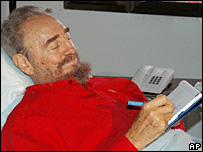
It's all but official - Fidel Castro is a goner. After missing a rally in Havana celebrating his 80th birthday, the entire world is waiting for Cuba's longtime caudillo to hurry up and die of cancer so they can deal with Cuba's new dictator, Fidel's younger brother Raúl. As, perhaps, proof of his political ascendancy, the younger Castro has broken with his elder brother's die hard stance regarding negotiations with Washington, a move that would be unthinkable if there were any thought of Fidel recovering.

While Fidel's health is classified as a state secret in Cuba, ordinary Cubans have put two and two together and deduced that el jefe must be on his way out - permanently. Hugo Chavez (who will be re-elected today) has assured the world that Fidel is just fine - a further sign to the Cuban people that Fidel will be dead in a month. It's all over but for the grave digging, so stay tuned.

Tuesday, November 14, 2006

"Don't call it a comeback"

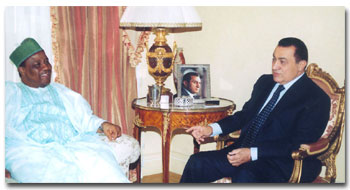
First of all, my apologies to LL Cool J for the title of this post, but it's just too fitting to pass up. What else could describe the attempts of Nigeria's former military dictator Ibrahim Badamasi Babangida (pictured at left with Egyptian dictator Hosni Mubarak) to stand as a candidate in Nigeria's 2007 presidential elections?

After taking power in a military coup in 1985, Babangida ruled as a classic African big man, and cut no corners to show his countrymen that he deserved to be discussed in the same sentences as his contemporaries in Zaire and Uganda. While at first styling himself as a political reformer, Babangida quickly discovered that ruling by decree freed him of tedious legislative busywork, and that his modest civil service salary and pension would necessarily be inferior, from a personal economics standpoint, to kleptocracy.

Babangida's comeback tour is not without precedent, as dictators of the 1980s have, more and more, been looking to return. Not all have been successful, such as Jean Claude "Baby Doc" Duvalier's ill-fated presidential campaign in Haiti, but really, if voters in Nicaragua could forgive Daniel Ortega, who's to say that Babangida won't tug on Nigerian heartstrings in the same way? One good, or even bad!, turn may truly deserve another.

By the time Babangida was ousted in a military coup by (the now deceased) General Sani Abacha, the ousted dictator had left little to show for his rule beyond a string of extrajudicial murders, human rights abuses, fraudulent elections, and empty state coffers. On the plus side, however, he does have his own website (viewable here), and I'm a sucker for a dictator with a website.

Monday, November 13, 2006

US sources: Fidel dying of cancer

Time Magazine is reporting that unnamed "American intelligence officials" are claiming that octogenarian Cuban dictator Fidel Castro is dying of cancer, corroborating earlier reports from Brazilian sources. The Cuban government, of course, is denying everything. Should Fidel live to see February 16, he will have been in power for 48 years - two more than the late Kim Il-Sung of North Korea.

Fidel's younger, yet still elderly, brother Raoul is currently ruling in Fidel's stead, and is expected to be Cuba's new dictator once Fidel kicks the bucket. We have yet to hear any official statements from the US government on what they expect from US-Cuba relations after Fidel. Similarly, Venezuelan caudillo Hugo Chavez, who has visited his mentor in the hospital, hasn't said a word about what he expects when his despicable role model has died. Expecting that Raoul, who is now 75, stays close to Fidel's line politically, Fidel's departure may mean very little indeed.

Friday, November 10, 2006

Lesson understood.


Now that the Butcher of Baghdad has been sentenced to hang, what have we learned?

I know it's a hoary question, but it's still a valid one. The European Union, fainting at the mere thought of violence, simply thinks it's wrong to execute anyone for any reason, as does Amnesty International. Opposition from these quarters was to be expected. After all, they tend to oppose the death penalty in more or less every instance, no matter who it is that's to be executed. No lessons learned here.

There have, however, been a few observers keen enough to learn one of the real lessons of Saddam's ignominious date with destiny. A group of Zimbabwean exiles in South Africa have welcomed Saddam's death sentence, and hopes it sends a message to Zimbabwe's dictator Robert Mugabe, as well as deposed dictators Augusto Pinochet of Chile and former Liberian dictator Charles Taylor, saying:

"[we] believe that together with the Pinochet, Taylor, and other recent cases, this case sends an unequivocally clear and resounding message to dictators and perpetrators of serious crimes under international and national laws. [We] hope that this loud message will not escape the ears of tyrants like President Robert Mugabe of Zimbabwe and all those who serve under him in the commission of torture and other crimes against humanity"
While stating that they "deplore the death penalty as a method of punishment", they welcome the trend of dictators facing justice at the hands of their former subjects in a court of law. As you can imagine, this trial has resonated strongly in countries who have recently rid themselves of their dictators, but less surprisingly, it's created quite an impression on another group: dictators still in power.

Egyptian strongman Hosni Mubarak is nervously talking about about the "instability" that Saddam's hanging will cause in Iraq, while Venezuelan caudillo Hugo Chavez predictably opposes Saddam's date with the gallows (although he just as predictably supports hanging George W. Bush).

Not surprisingly, most dictators have closed ranks around Saddam because they've drawn exactly the same conclusion as Iraqis and the aforementioned exiles in Zimbabwe have: if they ever have to account for their crimes in a courtroom of their own people, they're as good as dead. No dictator is afraid of the International Criminal Court in The Hague, and frankly, who can blame them? The extradition proceedings take an eternity. They confine you in large, well appointed quarters. And no matter what - under any circumstances - is there any chance of receiving the death penalty.

There isn't a dictator on earth that's afraid of receiving three hot meals a day and cable television for the rest of his life, when the alternative might be answering for genocide, torture and political repression at the end of a rope. Even merely being deposed and killed isn't regarded with quite the same horror. Nicolae Ceauşescu was tried in secret and shot, avoiding the indignity of hanging, and of having his victims testifying before him and making him confront his bloody hands.

Saddam's trial by free Iraqis represented exactly the sort of justice rulers like Saddam worked so hard to avoid, and I imagine that dictators across the world loosened their collars in discomfort when they heard the verdict. This is, quite literally, their worst case scenario - worse even than exile, prison, or being overthrown in a coup d'etat, or even dying in combat. There literally is nothing that scares them more than what Saddam is facing, and it's a fear they should certainly respect.

I don't know if the same day will ever come for Mugabe, Castro, or Omar al-Bashir, but Saddam's fate will give hope to the right people - the people currently being ground under the heel of dictators seeking to restore the justice they've been denied for too long.

Tuesday, November 07, 2006

Check.

Check. The former Iraqi dictator, Saddam Hussein, has been sentenced by a court in Baghdad to death by hanging for his role in orchestrating the massacre of Dujail in 1982.

Should his automatic appeal fail, Saddam's sentence will be carried out "within 30 days" after his appeal is exhausted. The appeal is scheduled to take place within the next 30 days as well, meaning, quite possibly, that the world may finally be rid of the Strongman of Tikrit once and for all before 2007.

The reaction in Iraq has been generally ecstatic. After all: what captive nation hasn't secretly dreamed of the day their tyrants are brought to heel by their terrified subjects? As usual, however, the European Union is sniffing about how uncivilized this hanging business is, and even one of Saddam's harshest critics is arguing for mercy.

Irony pervades Saddam's date with the hangman on a number of levels. Many of the European nations now opposing Saddam's future hanging showed some fondness for the noose themselves when dealing with the Germans who had terrorized their nations during the second world war. On another level, Saddam and the Ba'ath party were extremely fond of using public hangings as a means of maintaining control of the state. Now, of course, he's almost certainly going to feel what it's like when they tie the knot right behind his ear during the last minute of his wretched life.

Yet another level of irony is present here. For those people who don't know - or don't want to know - about the death penalty, hanging is considered a punishment for the lowest sorts of crimes committed by common criminals, like thieves, murderers and rapists. Saddam, of course, considers himself a military and political figure, and therefore, entitled to a more "honorable" execution by firing squad as befits a man of his stature. With any luck, he's already starting to feel the rope tighten around his neck, and the world will finally be rid of one of the 20th century's most bloodthirsty tyrants.

Monday, October 30, 2006

The gentler sex?

Recently, reader Eriqua left a comment, asking:

"do we have any modern examples of women dictators? I just wonder if the gender gap has been bridged"

This is a fairly good question. The answer is, somewhat surprisingly, not really. Even though it's a man's world, there have certainly been some notable female tyrants, but nearly all of them have been monarchs from centuries past. From Queen Ravanalona I ("The Cruel") of Madagascar to Empress Catherine II of Russia, one would normally find a crown on the head of a woman crushing her people under her heel.

Given the relatively small list of female national leaders, the question remains: where are the dictators? It is curious that for communism's alleged penchant for gender equity, not one of the leaders of the former Soviet Union, nor any of its satellite states, was a woman. Similarly, there were no women among the military brasshats taking power in South America or post-colonial Africa. Lots of superfluous military decorations, yards of shiny patent leather, but no estrogen. Even when Pakistan's Benazir Bhutto took the top job in a nation notorious for its dictatorships, she either failed, or elected not to, follow in the footsteps of some of her infamous contemporaries.

So where has the modern age, so rife with dictators, found a woman's touch? Naturally, there have been a number of dictators whose wives have played a role behind the scenes, but only one of them, Argentina's Eva Perón, took a public role alongside her dictator husband (a role she eventually renounced). One supposes there are other reasons for a lack of women dictators, ranging from the traditional links between military service and dictatorial rule, to the overall lack of women in prominent leadership roles around the world, but even considering the diminished opportunities, few female rulers have sought to rule with an iron fist as male rulers have.

The best I can think of is a woman who, while not a dictator in the strict sense of the word, did at one point exercise dictatorial control over her country: the late Indira Gandhi of India (pictured above, manhandling a hapless koala).

Riding high after crushing Pakistan in the 1971 war of Bangladeshi Independence and India's equally successful entry to the nuclear age, Gandhi was riding high until the country found itself paralyzed by a political crisis in 1975. Without hesitating, Gandhi suspended India's democracy during the (now infamous) "emergency period", during which time, she adopted dictatorial powers, including the all important ability to rule by decree.

During the two year emergency period, Gandhi rode roughshod over her political enemies, sending tens of thousands of political opponents to jail on specious charges, imposed strict press censorship, dismissing state officials perceived to be hostile to her rule, while simultaneously grooming her sons Sanjay and Rajiv for a more political role.

Gandhi's confidence proved to be her undoing. Believing the economic progress made during the emergency period added to her political prestige, she called for new elections in 1977, and was soundly trounced by the opposing BJP party. She removed herself from office without a struggle, thus ending the brief and only dictatorship by a woman in the last century. Indira returned to power again, with disastrous results, before being assassinated by her Sikh bodyguards in 1984.

Wednesday, October 25, 2006

Top 10 Profile: Saparmurat Niazov

Name: Saparmurat Atayevich Niazov
Born: Aşgabat, TSSR (USSR) February 19, 1940
Length of rule: June 21, 1991 - present (15 years)
Means of ascent to power: Elected
Style: Cult of personality

NOTES:

Quick: what the first thing you think of when you hear the word "Turkmenistan"? For most Americans, the answer would be "What-where-i-stan?". For people fascinated by dictators, however, the sleepy Central Asian republic is white hot, thanks to its viciously ruthless yet lovably eccentric tyrant, Saparmurat "Turkmenbashi" Niazov. With rumors of his imminent demise coming from all angles, it behooves me to provide a quick outline of one of the strangest dictators of the past century.

After the catastrophic dissolution of the Soviet Union, the backwater chunk of Central Asia formerly known as the Turkmen Soviet Socialist Republic found itself, for better or worse, an indepent nation. Politics, like nature, abhors a vacuum, but nobody really took much notice when the leader of the Turkmen Communist Party, an undistinguished hack named Saparmurat Niazov, won newly independent Turkmenistan's first, and last, presidential election in 1992.

Taking a cue from Kemal Atatürk, Niazov found the role of "president" a bit too limiting, preferring shrewdly to announce that he had become the very personification, and even the very essence of the Turkmen people themselves. Very soon, Saparmurat Niazov, the colorless Soviet apparatchik, restyled himself as the dynamic Turkmenbashi, meaning, "leader of all Turkmen".


Taking a cue from Josef Stalin, Niazov isolated his nation from the rest of the world and began building a formidable personality cult. In case anyone might think he's a one trick pony, Niazov also borrowed something from Mao Zedong (more specifically, Mao's odious Little Red Book): the Ruhnama.

Written as a national epic in a quasi-religious, quasi-nationalistic style, Niazov's Little Green Book humbly purports to be the equal of lesser known works like the Bible and the Koran. Lest anyone attempt to diminish the importance of his book, Niazov has made study of Ruhnama compulsory. If there is anyone in Turkmenistan seeking employment (in the public or private sector), anyone seeking a driver's license, anyone looking to get married, and so on, he or she had better be able to recite large portions of Ruhnama by heart.

More ominously, failing to praise the book is a crime against the state, to say nothing of the punishments awaiting anyone who might dare to actually criticize the book as the rantings of a senile dictator. Niazov is so enamored of his epic, he's erected statues - even buildings - in its likeness. When prominent Muslims in Turkmenistan complained about being compelled to put his book next to the Koran, Niazov simply had them thrown in jail and ordered their mosques bulldozed. Perhaps these old fashioned Muslims can be appeased by Niazov's entirely straightfaced declaration that anyone who reads Ruhnama three times will "automatically" be admitted to heaven. That sure beats blowing yourself up on a bus in Tel Aviv, doesn't it?

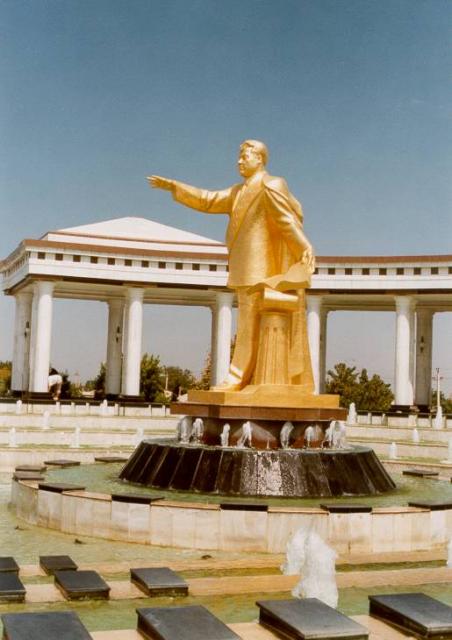
While officially downplaying the extent of his personality cult, Niazov has seen fit to allow several golden statues of his likeness to remain standing, including a marvelous statue that rotates to face the direction of the sun. It is, perhaps, his crushing ubiquity in Turkmenistan that has provided him to pass some of the world's stupidest laws without his people raising an eyebrow in surprise. These laws include, but are by no means limited to:

  • Outlawing gold teeth in favor of promoting "chewing bones"
  • Banning female newscasters from wearing cosmetics
  • Bans on karaoke and car stereos
  • Replacing the Hippocratic Oath with an oath of allegience to Niazov
It's not known for sure if Niazov's bizarre presidental decrees are serious, or merely an effort to deflect attention from his country's appalling human rights record and lousy economy. Whatever the case may be, Turkmenistan is unencumbered by serious political opposition to his rule, much less military threats from at home or abroad. As long as he keeps pumping natural gas to Europe, the rest of the world will be content to paint him as the eccentric ruler of a charming backwater, more than happy to ignore the less amusing aspects of his totalitarian rule.
Still, one has to admire Niazov's sense of style, and his eagerness to set himself apart from the other grey stuffed Soviet suits that took over other former Soviet Republics. Ever seen anything about Heider Aliev, Islam Karimov, or Nursultan Nazarbayev in the insufferable "wacky news of the day" section of your local newspaper?

Didn't think so.

Monday, October 23, 2006

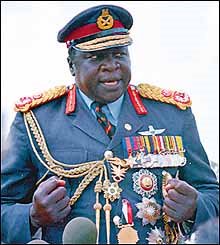
The Last King of Scotland

No, not James I, but the late, unlamented Idi Amin Dada of Uganda, is the focus of the new film The Last King of Scotland.

While the movie is clearly fiction, the real life and times of one of Africa's most notorious big men are brought to life in the movie, beginning with the overthrow of Uganda's previous dictator, to the economically disastrous expulsion of Uganda's "Asian" business class, to the militarily diastrous decision to provide assistance to Palestinian hijackers at Entebbe, the film reconstructs the timeline of Amin's bloody tyranny through the eyes of a Scottish doctor who manages to ingratiate himself to Amin.

Amin, of course, was no stranger to film during his lifetime, having appeared as himself in the bizarre documentary Idi Amin Dada, where he plays the accordion, mounts a mock invasion of the Golan Heights, and terrifies his subordinates, all while playing the role of a large, jolly man who feels wounded at being "misunderstood" at being portrayed as a bloodthirsty buffoon an unsympathetic Western press. Amin certainly didn't help his own cause, however, by murdering his political opponents, launching ill advised military actions against Uganda's neighbors. What's more, Amin's penchant for self-aggrandizing made him a popular target for Western reporters looking to portray him as an ignorant lout. Consider his modest, self-described title:

His Excellency President for Life Field Marshal Al Hadji Dr. Idi Amin, VC, DSO, MC, King of Scotland, Lord of All the Beasts of the Earth and Fishes of the Sea, and Conqueror of the British Empire in Africa in General and Uganda in Particular
His service in the King's African Rifles notwithstanding, Idi Amin's chances of being awarded the Victoria Cross were roughly equivalent to my chances of being Miss Venezuela. It was Amin's bufoonish side and boyish charm that unnervingly contrasted with his explosive temper, total paranoia and bloodthirsty appetite for revenge, making him equal only to Mobutu Sese Seko as the most notorious of Africa's big men.

So what did I think of the movie? As a dictator-phile, I was pleasantly surprised by Forest Whitaker's portrayal of Amin, delighted that he paid such close attention to Amin's own mannerisms and body language from Idi Amin Dada. I was less enthralled with the Scottish doctor as narrative device, the romantic and espionage subplots, et al., and look forward to the day when Hollywood is ready to tackle the dictator biopic with the seriousness and breadth of vision it deserves.

Thursday, September 28, 2006

"No - fuck YOU, Jon Stewart."

In a match up nobody demanded, the unshakable Pakistani dictator Pervez Musharraf appears opposite the unwatchable Jon Stewart on the insufferable Daily Show.

The YouTube video of these titanic mediocrities is here, while bitching and moaning on the equally insufferable Huffington Post appears here.

Wallechinsky's bellyaching aside, I am all for having dictators as guests on American television, but is it too much to ask for more entertaining dictators?

Friday, September 22, 2006

Thai King officially backs coup d'etat

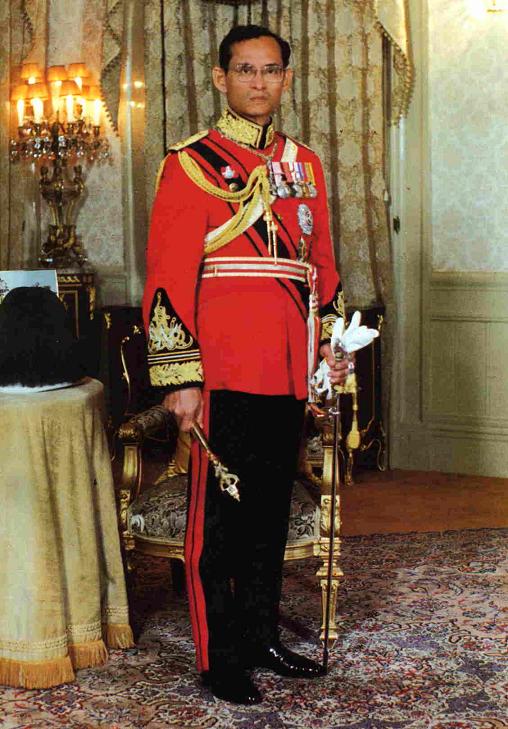
Thailand's King Bhumibol Adulyadej has made his tacit support of his country's military coup d'etat official. The English language Bangkok Post , His Majesty has been quoted as saying:

"For the sake of stability, we ask the people to be at ease, and to obey the instructions of General Sonthi"
This endorsement, while tepid in translated English, apparently packs enormous weight in Thailand, where The King wields political influence that overspills his somewhat more limited constitutionally mandated role. Indeed, the idea that the Royal Thai Army would depose the now widely detested former Prime Minister Thaksin Shinawatra without the explicit approval of His Majesty is widely considered to be utterly inconceiveable. With Shinawatra's political capital exhausted, General Sonthi has, quite rightly, deduced that his Majesty would repay the Army's undying loyalty to the throne with public support for the coup. You have to wonder if the monarch directed the Army to launch the coup, or if the generals simply knew that they would receive the King's support? With strict press censorship now in place, the answers are not forthcoming.

Jot Man continues to blog the coup, live from Bangkok, right here.

Thursday, September 21, 2006

The revolution will be televised (and then some)

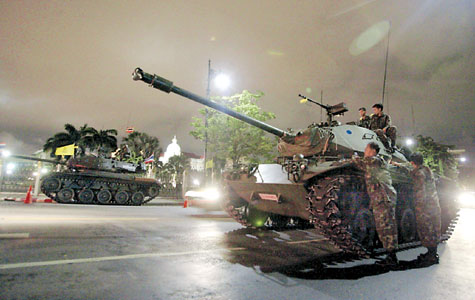
The military coup d'etat in Thailand appears to be a fait accompli at this point, and a kind soul with the nom de plume of Jot Man has thoughtfully been blogging his way through the action in Bangkok. His efforts are no doubt aided by Bangkok's position as the financial and technological capital of Southeast Asia. Whle there have been dozens of coup d'etats, both successful and attempted, in the past decade. Most of them, however, have been in dreary places with abysmal telecommunications infrastructure, like Equatorial Guinea, Sudan, Fiji, et al.

I find myself inspired by his hands on coverage, and now I'm wondering why I'm sitting on the sidelines, missing all the action. I have, therefore, provided my credentials to the Royal Thai Embassy in Washington, DC in an effort to secure a cabinet position in the, admittedly currently non-existent, "Ministry of Violence". Granted, Thailand is by and large a devoutly Buddhist nation, and the concept of an American assuming the post of Minister of Violence may seem to be at odds with the country's religious and cultural heritage.

I maintain that with this coup, Thailand has begun the transition to becoming a fully secular democracy. For example, General Sondhi Boonyaratkalin - a Muslim - has now appointed himself to the position of Prime Minister, signalling a breakthrough in political advancement for non-Buddhists in Thailand. I breathlessly await a reply, and news of a cabinet appointment, from his excellency the ambassador.

Wednesday, September 20, 2006

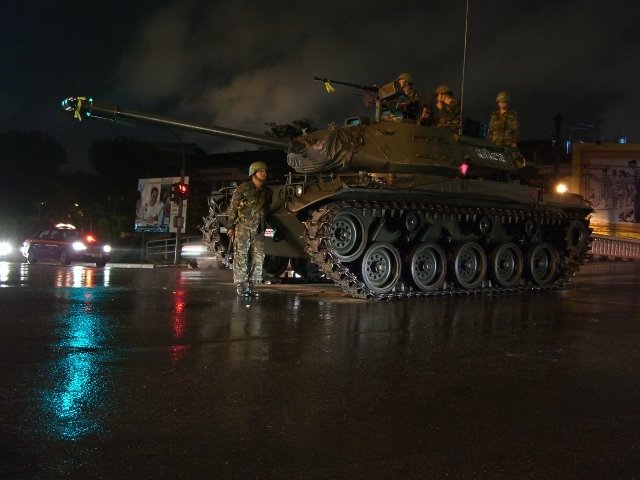
Coup d'etat!

When I'd heard that there had been a military coup d'etat in Southeast Asia, I immediately suspected that it had taken place in Cambodia, and hoped that, perhaps, the Vietnamese army had overthrown the moribund Communist regime in Hanoi.

But Thailand? Yes, Thailand. Rumors of a military coup had, apparently, been swirling for months as a result of the nation's political crisis, and now, the army has pulled the trigger.

General Sondhi Boonyaratkalin of the Royal Thai Army is now Prime Minister of Thailand after the current Prime Minister, the much loathed Thaksin Shinawatra, was deposed in a bloodless coup while out of the country to attend meetings at the United Nations.

While international messages of "concern" are issued, the coup appears to have broad support from the Thai people and carries at least the tacit support of the King. The General, however, claims that this is just a temporary move, saying:

We would like to reaffirm that we don't have any intention to rule the country and will return power to the Thai people as soon as possible.
It remains to be seen if the General will make good on his word to restore democracy to Thailand, thus ending his brief career as dictator, but veteran dictator enthusiasts have heard the "we will restore democracy soon" line from nearly every single ursurping brasshat from the late Mobutu Sese Seko to Pervez Musharraf. Needless to say, nobody should hold their breath.

Wednesday, September 13, 2006

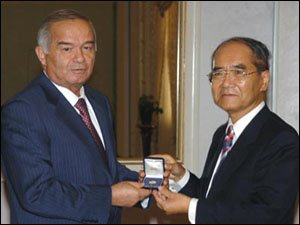
UNESCO honors Uzbek dictator Karimov


If there is any other person, place or organization that is at ease with dictators as I am, it would have to be the United Nations. Last week, UNESCO director-general Koichiro Matsuura awarded Uzbek dictator Islam Karimov with the organization's gold "Borobudur Award" in recognition of the Central Asian strongman's "efforts on behalf of friendship between peoples".

Neither Mr. Matsuura, nor the state controlled Uzbek press, elaborated on just which peoples, exactly, Karimov is credited with fostering friendship between. I would have to guess that "the peoples" in question are foreign energy ministers and Uzbek treasury officials, but I suppose I'm just a cynic. However, I do feel fairly confident in speculating that UNESCO did not award Karimov with a medal for Karimov's efforts on fostering friendship between the Uzbek state and, say, Uzbek political dissidents, Uzbekistan's neighbors, journalists, or even the the dictator's own unhappy subjects.

On the one hand, it's easy to be appalled with the United Nations wasting money handing out frivolous awards. On the other hand, I can't wait to see which dictator or brasshat is feted by UNESCO next. Isn't there some cultural award they can give to Robert Mugabe, or Muammar Gadaffi for their lifetime acheivements? And won't some faceless international technocrat please recognize that Kim Jong-Il and Saparmurat "Turkmenbashi" Niazov are likely to feel slighted at being left out?

I would certainly hope, at the very least, that there enough Borobudur Awards to go around until every dictator has had a chance to win.

Friday, August 18, 2006

Comrade Bob in the news

Zimbabwe's dictator Robert Mugabe is showing no signs of slowing - or stepping - down in his old age.

In a week where he has publically threatened his political opponents and taken further steps to ruin his nation's already demolished economy, it's rumored that the 82 year old Mugabe took a little "me time" overseas.

The state run Herald published the photo (above) which fueled rumors that the elderly dictator has had a facelift. Mugabe, naturally, was unwilling to confirm or deny rumors that he's had frivolous surgery while his once prosperous nation continues its slow and steady slide into mayhem.

Thursday, August 17, 2006

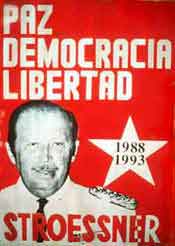
Alfredo Stroessner

Finally! Some dictator news that doesn't involve Fidel Castro or Hugo Chavez.

Yesterday, the exiled former dictator of Paraguay Generalissimo Alfredo Stroessner, died of pneumonia at age 93 in Brasilia, Brazil.

Stroessner had been out of the political picture since his ouster in a 1989 military coup, but managed to control Paraguay with an iron fist for 35 years. After fighting in Paraguay's disastrous Chaco War, Stroessner rose metorically through the ranks of the Paraguayan military, attaining the rank of Brigadier General by the very young age of 36.

In 1954, Stroessner knocked out the president of Paraguay in a military coup, and proceeded to hold onto power for the next 35 years, a record only Fidel Castro has broken in the Americas. A dedicated anti-communist, Stroessner never attempted to explain his own political philosophy in very much depth, but the political style of his autocratic rule leaned towards state nationalism and fascism, which certainly may have explained his prediliction for offering political asylum in Paraguay to fugitive Nazi war criminals, including the Angel of Death himself, Josef Menegele.

On the foreign stage, Stroessner leaned towards isolationism. His anti-communist stance put him in America's good graces starting with the Eisenhower administration, but he found himself abandoned by the United States after presidents Carter and Reagan cut political ties with him over Paraguay's abysmal human rights record. On the domestic front, Stroessner has been grudgingly credited with making tangible improvements to Paraguay's infrastructure and economy, including greenlighting and financing Paraguayan participation in the massive Itaipu dam project that turned his impoverished nation into an energy exporter.

With Stroessner's passing, the age of the right wing South American generalissimo is quickly drawing to a close. Only Jorge Videla of Argentina and Augusto Pinochet of Chile remain alive (if deposed), and both are elderly and frail. Clearly, the era of strutting banana republic brasshats has ended. The new breed of dictators, epitomized by the likes of the like of Hugo Chavez, have changed the political and personal style, but the substance remains more or less the same.

Monday, August 14, 2006

All Castro, all the time

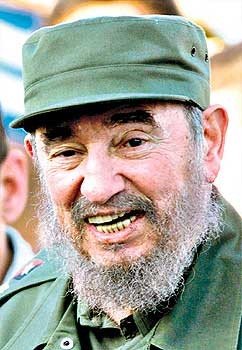
Are there no other dictators in the news lately? I almost feel that I'm being unfair to Fidel Castro, who spent his 80th birthday in a hospital bed, recovering from intestinal surgery.

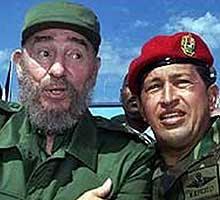
Never one to miss a photo opportunity with the old man, Venezuela's Hugo Chavez flew to Havana to visit his ailing political role model and wish him well. It's nice to see that some romances, however loathesome, are built to last. Here's hoping that Godzilla rises from the sea and stamps both of them out like a cigarette butt.

Speaking of Chavez, would anyone like to speculate how the infusion of the Venezuelan petrodollars keeping the flyblown carcass of Cuba's economy afloat is going to complicate the fight for succession when Fidel kicks the bucket? No sane person would suggest that Raul Castro would risk losing Hugo's precious economic assistance by daring to ease political pressure on internal dissidents, liberalize trade, or seek better relations with the United States. More to the point, when the elderly Raul dies, who plays kingmaker? There is no apparent chain of succession after the younger Castro - a situation that puts Chavez in control until his oil money runs out, or better yet, is deposed in a coup himself.

Now seriously, I'm getting bored with the gruesome twosome. What has Robert Mugabe been up to lately?

Tuesday, August 08, 2006

Castro hangs on

One week after transferring power to his brother Raúl, Cuban dictator Fidel Castro is still recuperating from surgery to repair intestinal bleeding. Christopher Hitchens is of the opinion that this transfer of power amounts to a soft military coup, but despite any simple comparisons to Poland's former dictator, it seems all but assured that Fidel will be coming back to power if and when he recovers from his mysterious illness.

Yet if Fidel dies, what comes next? Would his brother, who is also head of the Cuban armed forces, institute martial law? Would he seek detente with the west? Would Hugo Chavez, having bought his way into Cuba's political system, dictate the terms of succession? Would the US sit idly by in the case of a power vacuum in Cuba? Or will the creaky Soviet style totalitarian relic creak onwards, financed by Venezuelan charity indefinitely?

Tuesday, August 01, 2006

Finale for Fidel?

Could it be curtains for Castro? In an unprecendented move, Fidel Castro has temporarily ceded control of Cuba to his younger brother Raul (pictured above at right) while undergoing intestinal surgery for a "stress" related complaint. Castro, who will be 80 years old on August 13, has ruled Cuba since January 1, 1959, making him the longest serving dictator in living memory (having surpassed Kim Il-Sung's 46 year reign in North Korea).

It is worth recounting that Fidel once warned the CIA that Raul would take control of Cuba in the event of his death, and said ominously "and Raul is far more radical than I am". One wonders if old age has tempered Raul, but it doesn't seem to have done much to improve the elderly Fidel's disposition. Should Fidel kick the bucket, the future of dinosaur Marxism in the Americas will likely skip over Raul and go to Fidel's loathesome comrade, Hugo Chávez of Venezuela.

Monday, July 31, 2006

Saddam and Syria in the news


I've long since returned from vacation, but I've been terribly remiss in updating this blog. Then again, most of the world's dictators have been laying low. I'm not the only one who takes some vacation time in the summer, after all!

One dictator who has been in the news lately is former Iraqi strongman Saddam Hussein who has recently broken his hunger strike, and told his prosecutors that, if convicted, he would rather be shot by a firing squad than hanged. In this age of execution by lethal injection, we have become somewhat squeamish about capital punishment, and some people may have forgotten that hanging is a punishment traditionally reserved for common criminals - an indignity Saddam feels is beneath him as befits his status as president of Iraq. Well, former president of Iraq, but Saddam has never quite accepted his demotion from "president" to "defendant" in a graceful way.

Staying the Middle East, one may have noticed the current dust up between Israel and Hezbollah. I cannot help but wonder: was the Hezbollah offensive that triggered this war part of a power play by Syrian dictator Bashar al-Assad to strengthen Syria's weakening grip on its former client state, Lebanon?

After the hamfisted assassination of Rafik Hariri and the subsequent diastrous (for Syria, anyway) Cedar Revolution, it seemed Lebanon's days as a de facto Syrian colony were at an end. Could the junior Assad be as inept as the senior Assad was shrewd? Are Damascus and Tehran waging their proxy war against Israel to satisfy hard liners domestically? Does Assad hope to reverse Syria's loss of regional influence? Most importantly, why has Assad been silent during the fighting? Obviously, Assad doesn't dare challenge Israel directly, and he certainly won't be sending the Syrian military back to Southern Lebanon while the nearly invincible Israeli military is there. Given the current anti-Israeli mood in Europe and the United Nations, it seems safe to bet that he's weighing the pros and cons of jumping back into Lebanon the very second the Israelis pull out.

I have always thought Bashar al-Assad to be a shadow of the dictator his father was, but if he's looking through his father's old playbook for the next move, I may be forced to review my estimation of his skills as a dictator.