Showing posts with label Top 10 Profile. Show all posts

Wednesday, July 04, 2007

Top 10 Profile: Adolf Hitler

Name: Adolf Hitler
Born: April 20, 1889 in Braunau am Inn, Austria
Died: April 30, 1945 in Berlin, Germany
Length of rule: January 30, 1933 - April 30, 1945 (12 years)
Means of ascent to power: Quasi-democratic
Means of removal from power: Committed suicide to avoid capture
Style: Police state, cult of personality, fascist, national socialist

NOTES:

Even though Adolf Hitler is arguably the 20th century's most infamous dictator, his very notoriety makes him a difficult topic to analyze rationally. We in the Western world all know the man's basic biography by now: born in Austria, a failed artist, wounded in the first world war, attempted to overthrow the German government in a clumsy putsch, took power more or less democratically before seizing total power, started a ruinous war, instituted genocide and finally, killed himself and his girlfriend to avoid capture by the Soviet Red Army. In fact, thanks to Hitler's infamy, he may be the most intensely studied dictator in world history. Ever watch The History Channel? The Hitler Channel is more like it. No matter where we go, there are comparisons of X to Hitler, warnings about "new Hitlers", footage of Hitler, soundbites of Hitler, usage of Hitler as a metaphor for raw evil, and so on.

All of this is fine and useful up to a degree, but the West's ceaseless interest in all things Hitler tends to overlook the finer points of what Hitler was like as a dictator. How did he assume power so easily? Who were his political role models? What was his relationship with other leaders really like?

We know that Hitler was certainly faced a gap between his boundless political ambition and his actual political conviction. Hitler drew his inspiration from Europe's contemporary revolutionary movements. Hitler certainly admired Italian dictator Benito Mussolini's fascist doctrine, but what good is mere ideology alone? Hitler also greatly respected the willingness of the burgeoning socialist revolutionary movements to resort to utterly ruthless violence to achieve their political ends. At some point, Hitler appears to have asked himself: what if Red violence were tied to the power of a fascist state? What would the characteristics of empire engaging in a perpetual statist revolution be? While Josef Stalin arguably beat Hitler to the punch in mixing leftist revolutionary violence with omnipresent state authority, Hitler nevertheless found the combination quite potent.

As a dictator, Hitler let his cunning and unerring political instincts fill in any troublesome ideological gaps. When Hitler wiped out his potential political rivals during the infamous night of the long knives, no less an authority than Stalin himself exclaimed admiringly, "that's how you do it!" And while his comical penchant for dramatic Wagnerian aesthetics and military pageantry was ridiculed at home and abroad, Hitler's innate grasp of politics found a way to make his dictatorship resonate emotionally with the masses in a way that eluded Stalin or Mussolini. After all, Hitler argued, the all-powerful state is the culmination of your revolution!

With a pervasive cult of personality to win the adoration of the masses and a disciplined secret police to weed out enemies, Hitler kept himself at the center of attention at all times, recognizing the need for the dictator to constantly be the focus of political attention. His admirers, both domestic and foreign, were enthralled by how the drab little Austrian became an electrified man of action in rebuilding a Germany shattered by war. And Hitler certainly recognized the value of being the center of world attention. No other dictator in history, not even Saddam Hussein, managed to crowd the spotlight so effectively. Even 60 years after his death, Hitler's loathsome fans find a way to stay enthralled. How many dictators can say that?

So where did Adolf's hold on power slip? It's quite simple: he flatted himself into believing that he possessed a talent for military leadership that simply didn't exist. While his political instincts were excellent (Hitler correctly foresaw the willingness of France, England and the Soviet Union to capitulate to German demands), he wound up biting off far more than he could chew when he insisted on overruling his generals on actual military decisions. Leading the masses is one thing, but leading troops? That's a job best left to the professionals.

In a way, it's a shame we've (somewhat understandably) reduced Hitler to an empty cartoon embodiment of pure evil, because this gets in the way of understanding the real man and real events of his time with the proper distance and seriousness they deserve. Hitler is the most famous dictator on my top 10 list, while simultaneously being the most frustrating to talk about. The most analyzed tyrant in history is also still the biggest blank slate when it comes to putting the pieces together. People have attempted to build psychological profiles of Hitler to little avail. We've asked if he was a homosexual, what role his vegetarianism may have played in his personality, how deep his anti-semitism ran on a personal level, what impact his failure as an artist had on his ambitions, and so on ad nauseam. I could talk about Hitler for a month straight and still feel like I've added nothing new.

So perhaps the readers who voted for Hitler in the last Top 10 profile contest can tell me: what do you want to know about Adolf Hitler?

Monday, July 02, 2007

The masses have spoken!

The polls are closed! The vote to choose the next dictator to receive a Top 10 profile has ended, and the masses have chosen German Führer Adolf Hitler as the next tyrant to be profiled on Dictators of the World. It's like 1933 all over again! Hitler's 30% share trumped heavyweights Josef Stalin (25%) and Mao Zedong (17.5%) and also unfortunately trounced my personal favorite, François "Papa Doc" Duvalier (2.5%). To be honest, I was dreading Hitler's triumph, will or no will. I'm really going to have to dig a bit to avoid a standard biographical rehash a la The History Channel.

Der Führer will get what's coming to him shortly, after which, the field of contestants will be reduced to five. Who will be next? And why isn't poor Enver Hoxha getting any votes?

Monday, June 25, 2007

Less than a week remains

Less than a week remains to vote for the next Dictators of the World tyrant to receive a top 10 profile. Who's winning? Well, so far, Josef Stalin and Adolf Hitler are locked in a struggle for supremacy. Hmm, sounds familiar, doesn't it? While the heavyweights duke it out, there's still time for a come from behind win by the likes of François "Papa Doc" Duvalier or Enver Hoxha, and I have a feeling this one could go down to the wire.

So why wait? Let me know which autocrat tickles your fancy by voting in the poll located on the right sidebar.

Tuesday, May 29, 2007

Vote or Die!

There's still one month left to vote for the next dictator to receive a top 10 profile, but so far, the results aren't encouraging. There have been only 14 votes, and so far, Adolf Hitler is winning. If you haven't voted yet, do so today by clicking on the dictator of your choice in the sidebar and submitting the results.

UPDATE: Not related to the poll, really, but this blog has climbed to the fourth highest Google result for "dictators of the world". Not too bad considering it was number six back in February.

Wednesday, May 09, 2007

It's that time again


Once again, comrades, it's time to vote for the next dictator to receive a Top 10 profile. When last we voted, you, the readers, chose North Korean dictator Kim Il-Sung as your Eternal Great Leader. But man cannot live by juche alone, and so we will be voting for a new top 10 dictator to have a day in the sun.

The field is now down to six. Will it be ...

  • Fidel Castro?
  • François Duvalier?
  • Adolf Hitler?
  • Enver Hoxha?
  • Josef Stalin?
  • Mao Zedong?
The poll is on the right in the blog's sidebar. Vote early, vote often, vote ... OR ELSE. The poll closes on July 1st, which is also when a winner will be announced. We wish all the "winners" the worst of luck.

Thursday, February 08, 2007

Top 10 Profile: Kim Il-Sung


NAME: Kim Il-Sung
BORN: April 12, 1912 (Pyongyang, Japanese occupied Korea)
DIED: July 8, 1994 (Pyongyang, North Korea)
LENGTH OF RULE: (officially) July 27, 1953 - July 8, 1994 (48.9 years)
MEANS OF ASCENT TO POWER: Leader of the Korean Workers' Party
MEANS OF REMOVAL FROM POWER: Died in office of natural causes.
Style: Totalitarian, Police State, Cult of Personality, Stalinist monarchy

NOTES:

Until Fidel Castro managed to live until his 80th birthday, Kim Il-Sung was the longest reigning dictator of the 20th century. The length of his rule notwithstanding, however, Kim's greatest accomplishment is something that eluded even the canniest of dictators: complete deification.

The fact that Kim Il-Sung is now worshiped as something resembling a God in the Communist (and officially atheist) North Korea makes determining his actual biography nearly impossible. The "official" biography provided by the North Korean government states that he was born as Kim Sung Ju to a poor, but ardently nationalist!, family in what is now North Korea.

His family fled Korea to the equally Japanese controlled Manchukuo in 1920, during which time, the young Kim learned about socialism, and joined an anti-Japanese guerrilla army led by the Chinese Communist Party. When the Japanese pushed the guerrillas back, Kim (now using the nom de guerre of "Kim Il-Sung") fled north again, this time to the Soviet Union, and joined the Red Army, eventually rising to the rank of captain. The true extent of Kim's involvement during the fight against the Imperial Japanese Army during the second world war will never be known for sure. To hear the official North Korean line, Kim had nearly beaten Japan single handedly until those meddling Westerners arrived and stole all the glory for imperialist reasons.

What occurred next is well documented, and beyond dispute. After the end of the war, the Soviet Union occupied Korea north of the 38th parallel. A savvy political operator, Kim quickly rose to the top of the Communist Korean Worker's Party - thereby establishing himself as the most powerful Korean Communist in Soviet occupied Korea. After installing Kim as the "Prime Minister" of the "Democratic People's Republic of Korea", Soviet dictator Josef Stalin rewarded his newest client state with generous donations of military hardware, and Soviet military training. Stalin's hints were obvious, and Kim responded predictably.

After the dust settled, Kim Il-Sung became the undisputed "Great Leader", and worked quickly to build an all-encompassing personality cult that established himself as the sole font of knowledge, justice, wisdom and righteousness, not only of Korea, but in the entire history of the world. Eager to differentiate North Korea from other run-of-the-mill Communist dictatorships, Kim announced the development of juche thought. Ostensibly meaning "self-reliance", juche has become an all encompassing political, social, and even quasi-religious philosophy guiding North Korea. The main tenets of juche are devoted to - surprise! - deification of Kim Il-Sung and the supremacy of the North Korean state.

For nearly 50 years, Kim Il-Sung made sure that every single facet of life in North Korea was controlled by the government (and by extension, himself). Kim Il-Sung looked to his former mentor, Josef Stalin, in establishing an all-seeing, all-knowing secret police. Naturally, Kim also demanded the creation of a system of gulags for the punishment of "political crimes". Information was controlled to such an extent, that North Koreans under Kim Il-Sung spent their entire lives believing that their nation was wealthy, and that South Korea was the poorest nation in the world. Radios and televisions were preset to receive only one station and channel, and any distribution of knowledge or information outside official channels was punished with extreme prejudice.

After his death in 1994, his pudgy son Kim Jong-Il assumed control of the ship of state, and picked right up where papa Kim left off, thereby establishing North Korea as the world's first Communist monarchy. Of course, Kim Jong-Il's implementation of juche has not been as "self-reliant" as his father's was, and doubtlessly, the senior Kim would disapprove of his son's half-assed attempts at raising money. Still, the Kim dynasty still has its dimwitted groupies and true believers, a fitting testament to Kim Il-Sung's self-transformation from mere dictator, to eternal demigod.

Monday, February 05, 2007

Poll's closed!

We have a winner! The voting has ended, and North Korean dictator Kim Il-Sung has triumphed over François "Papa Doc" Duvalier and Fidel Castro as your choice to be the next Top 10 dictator profiled on Dictators of the World!

Congratulations to all the contestants, and look for the plucky progenitor of juche thought to be profiled in depth this week.

Wednesday, October 25, 2006

Top 10 Profile: Saparmurat Niazov

Name: Saparmurat Atayevich Niazov
Born: Aşgabat, TSSR (USSR) February 19, 1940
Length of rule: June 21, 1991 - present (15 years)
Means of ascent to power: Elected
Style: Cult of personality

NOTES:

Quick: what the first thing you think of when you hear the word "Turkmenistan"? For most Americans, the answer would be "What-where-i-stan?". For people fascinated by dictators, however, the sleepy Central Asian republic is white hot, thanks to its viciously ruthless yet lovably eccentric tyrant, Saparmurat "Turkmenbashi" Niazov. With rumors of his imminent demise coming from all angles, it behooves me to provide a quick outline of one of the strangest dictators of the past century.

After the catastrophic dissolution of the Soviet Union, the backwater chunk of Central Asia formerly known as the Turkmen Soviet Socialist Republic found itself, for better or worse, an indepent nation. Politics, like nature, abhors a vacuum, but nobody really took much notice when the leader of the Turkmen Communist Party, an undistinguished hack named Saparmurat Niazov, won newly independent Turkmenistan's first, and last, presidential election in 1992.

Taking a cue from Kemal Atatürk, Niazov found the role of "president" a bit too limiting, preferring shrewdly to announce that he had become the very personification, and even the very essence of the Turkmen people themselves. Very soon, Saparmurat Niazov, the colorless Soviet apparatchik, restyled himself as the dynamic Turkmenbashi, meaning, "leader of all Turkmen".


Taking a cue from Josef Stalin, Niazov isolated his nation from the rest of the world and began building a formidable personality cult. In case anyone might think he's a one trick pony, Niazov also borrowed something from Mao Zedong (more specifically, Mao's odious Little Red Book): the Ruhnama.

Written as a national epic in a quasi-religious, quasi-nationalistic style, Niazov's Little Green Book humbly purports to be the equal of lesser known works like the Bible and the Koran. Lest anyone attempt to diminish the importance of his book, Niazov has made study of Ruhnama compulsory. If there is anyone in Turkmenistan seeking employment (in the public or private sector), anyone seeking a driver's license, anyone looking to get married, and so on, he or she had better be able to recite large portions of Ruhnama by heart.

More ominously, failing to praise the book is a crime against the state, to say nothing of the punishments awaiting anyone who might dare to actually criticize the book as the rantings of a senile dictator. Niazov is so enamored of his epic, he's erected statues - even buildings - in its likeness. When prominent Muslims in Turkmenistan complained about being compelled to put his book next to the Koran, Niazov simply had them thrown in jail and ordered their mosques bulldozed. Perhaps these old fashioned Muslims can be appeased by Niazov's entirely straightfaced declaration that anyone who reads Ruhnama three times will "automatically" be admitted to heaven. That sure beats blowing yourself up on a bus in Tel Aviv, doesn't it?

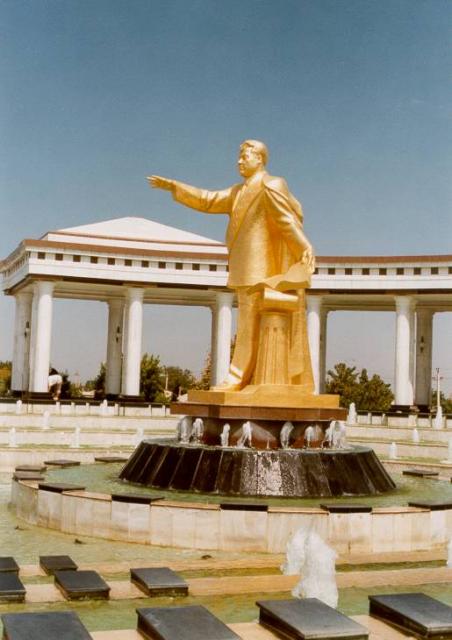
While officially downplaying the extent of his personality cult, Niazov has seen fit to allow several golden statues of his likeness to remain standing, including a marvelous statue that rotates to face the direction of the sun. It is, perhaps, his crushing ubiquity in Turkmenistan that has provided him to pass some of the world's stupidest laws without his people raising an eyebrow in surprise. These laws include, but are by no means limited to:

  • Outlawing gold teeth in favor of promoting "chewing bones"
  • Banning female newscasters from wearing cosmetics
  • Bans on karaoke and car stereos
  • Replacing the Hippocratic Oath with an oath of allegience to Niazov
It's not known for sure if Niazov's bizarre presidental decrees are serious, or merely an effort to deflect attention from his country's appalling human rights record and lousy economy. Whatever the case may be, Turkmenistan is unencumbered by serious political opposition to his rule, much less military threats from at home or abroad. As long as he keeps pumping natural gas to Europe, the rest of the world will be content to paint him as the eccentric ruler of a charming backwater, more than happy to ignore the less amusing aspects of his totalitarian rule.
Still, one has to admire Niazov's sense of style, and his eagerness to set himself apart from the other grey stuffed Soviet suits that took over other former Soviet Republics. Ever seen anything about Heider Aliev, Islam Karimov, or Nursultan Nazarbayev in the insufferable "wacky news of the day" section of your local newspaper?

Didn't think so.

Sunday, May 14, 2006

Top 10 Profile: Nicolae Ceauşescu

Name: Nicolae Ceauşescu
Born: January 26, 1918 in Scorniceşti, Romania
Died: December 25, 1989 in Târgovişte, Romania
Length of rule: July 11, 1965 - December 25, 1989 (33.5 years)
Means of ascent to power: leading Romania's communist party
Means of removal from power: overthrown in a coup d'état and executed
Style: Police state, cult of personality, Stalinist quasi-monarchy

NOTES:

On Christmas Day in 1989, the entire world was given a gift. After being overthrown in a coup d'etat, Nicolae and wife Elena Ceauşescu were convicted on the charge of genocide by a revolutionary kangaroo court, led down to a dingy basement, and shot to death by an army officer wielding a submachine gun. Normally, the civilized world frowns on coups, kangaroo courts and capital punishment, but in this case, the world kept quiet.

For over 30 years, Nicolae Ceauşescu and his wife Elena turned the Warsaw Pact nation of Romania into a laboratory for fear, misery and poverty. Assuming power in 1965 after the death of his predecessor, Ceauşescu quickly consolidated power by neutralizing his political rivals in the Romanian Communist Party, and by reorganizing the structure of Romania's dreaded secret police organization (the infamous Securitate) into a tool capable of completely repressing public political expression and dissent. He was just warming up.

Following a visit to fellow dictator Kim il-Sung in 1971, Ceauşescu apparently realized that he had been something of a piker as a dictator when compared to the godlike Kim. Taking cues from North Korea, Ceauşescu embarked on the creation of a "his and hers" dictatorship by means of a personality cult devoted to himself and his wife Elena, while also embarking on a disastrous policy of economic collectivization that transformed an already economically fragile nation into a poorhouse.

Apparently feeling that there were too few Romanians to lord over, Ceauşescu banned both contraception and abortion, leading an explosion of children that could not be fed, housed, nor cared for. This population explosion led to an increase in Romania's foreign debt, which Ceauşescu unwisely helped deal with by exporting Romania's already insufficient grain harvest, thus creating poverty and food shortages extreme even by the standards of a Communist country. With the exception of Enver Hoxha's isolationist dictatorship in Albania, the Ceauşescus excercised a personal control of a nation unknown in Europe since the death of Josef Stalin.

By the late 1980's, the entire Warsaw Pact began to collapse around Ceauşescu's ears. Without international support, nobody was willing to spend any amount of time, money or manpower to prop up Ceauşescu's decrepit autocracy, and in 1989, the end finally came.

After rising economic discontent led to an unprecedented public demonstration and uprising in the city of Timişoara, Ceauşescu ordered the Securitate and Romanian army to brutally disperse the crowds and punish the leaders of the demonstration.

After returning from a state visit to Iran, Nicolae and Elena Ceauşescu were horrified to find that the demonstrations had spread to Bucharest, and that during their two day absence, the leadership of the Securitate and Romanian army wisely decided to shift their loyalties from the despised Ceauşescus and launched a coup d'etat. The Ceauşescus never had a chance.

The dictator and his wife attempted to flee by helicopter, but were grounded by orders of the new anti-Ceauşescu military. Attempting to flee by car, they were stopped by civilian police in Târgovişte. The police detained the "mother and father of Romania" in the back seat while listening to the radio to determine if the anti-Ceauşescu coup would succeed. It did.

On Christmas Day in 1989, it was all over, and pictures of Nicolae and Elena Ceauşescu's bullet ridden bodies were sent to foreign press outlets over the world, without so much as a peep of protest. It seems that the entire world had finally had enough of the loathesome Romanian strongman and his insufferable wife.

What set Ceauşescu apart from some of his contemporaries was the enormous lingering damage done to Romania's social and economic fabric. While other Eastern European nations have recovered from the damage done by Communism, Romania's enforced population boom created millions of orphaned children, many of whom were infected with HIV by Romania's miserable public health system. To this day, Romania lags behind her former Warsaw Pact allies in Poland, Hungary and elsewhere in every measureably standard of economic and social progress, and all because of the megalomania of Nicolae and Elena Ceauşescu.

Wednesday, May 10, 2006

Top 10 Profile: Kemal Atatürk

Name: Mustafa Kemal Atatürk
Born: Thessaloniki, Greece (formerly part of the Ottoman Empire) 1881
Died: Istanbul, Turkey November 10, 1938
Length of rule: 15 years (October 1923 until his death in 1938)
Means of ascent to power: Military victory
Means of removal from power: Died while in power
Style: Benevolent dictatorship, cult of personality

NOTES:

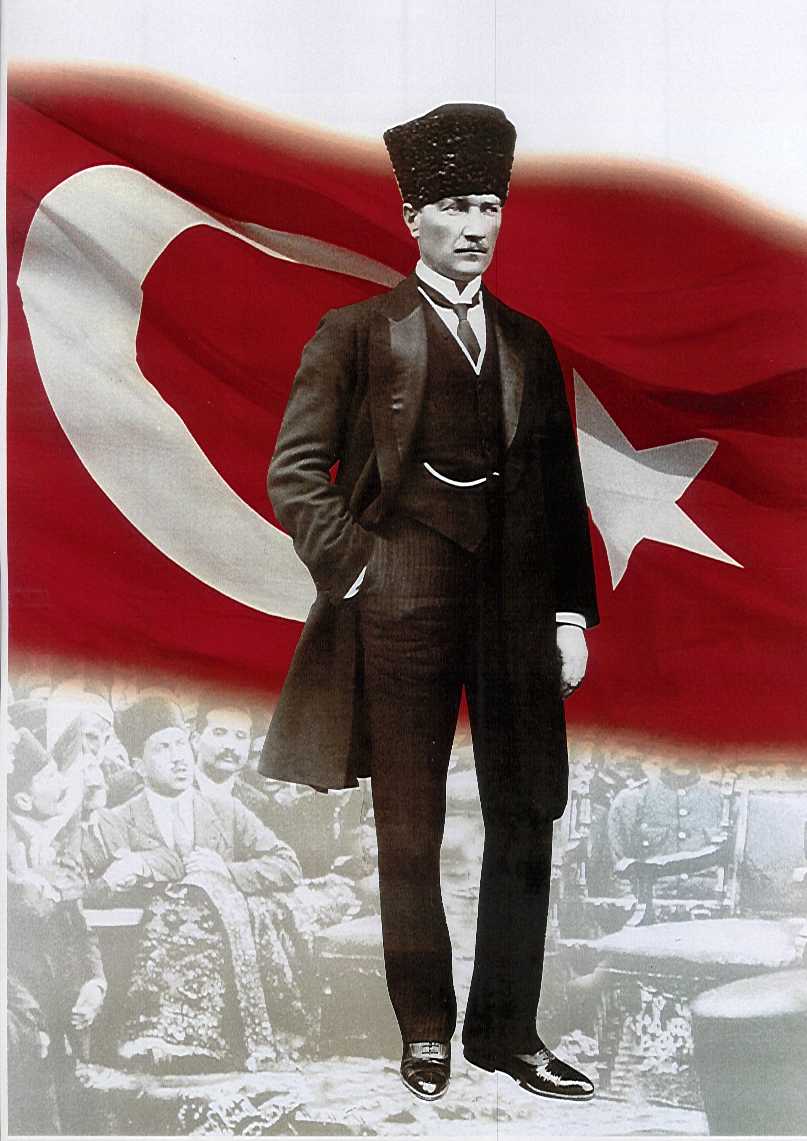
It may be argued that no other 20th century leader has left so large a mark on his nation as Kemal Atatürk. Following the defeat of the Ottoman Empire in World War One, Atatürk rebuilt his nation from the ground up.

Atatürk's most notable, almost impossible, achievement was the transformation of the Islamic Ottoman Empire into the politically secular Republic of Turkey. On paper, this doesn't seem very impressive, but the political and social impact changed the face of the Muslim world forever. Continuing from there, Atatürk remolded the image of his people from the pan-Islamic religious identity into a solidly Turkish nationalist one. Atatürk turned away from the Middle East and looked towards Europe for new modes of dress, and even introduced orthographic reform for the Turkish language by abolishing the Arabic script Turks had used for centuries and mandating the use of the Roman alphabet.

Since his death, Atatürk has become the embodiment of Turkey and of Turkishness. Indeed, criticism of Atatürk is unthinkable - even illegal - in Turkey to this day. None of the other dictators on my top 10 list (not even Mao or Stalin) have had the same lasting social, cultural or political impacts on their subjects as Atatürk has had on his.